Engaging with children’s fear and anxiety about I.C.E. in healthy ways
News –
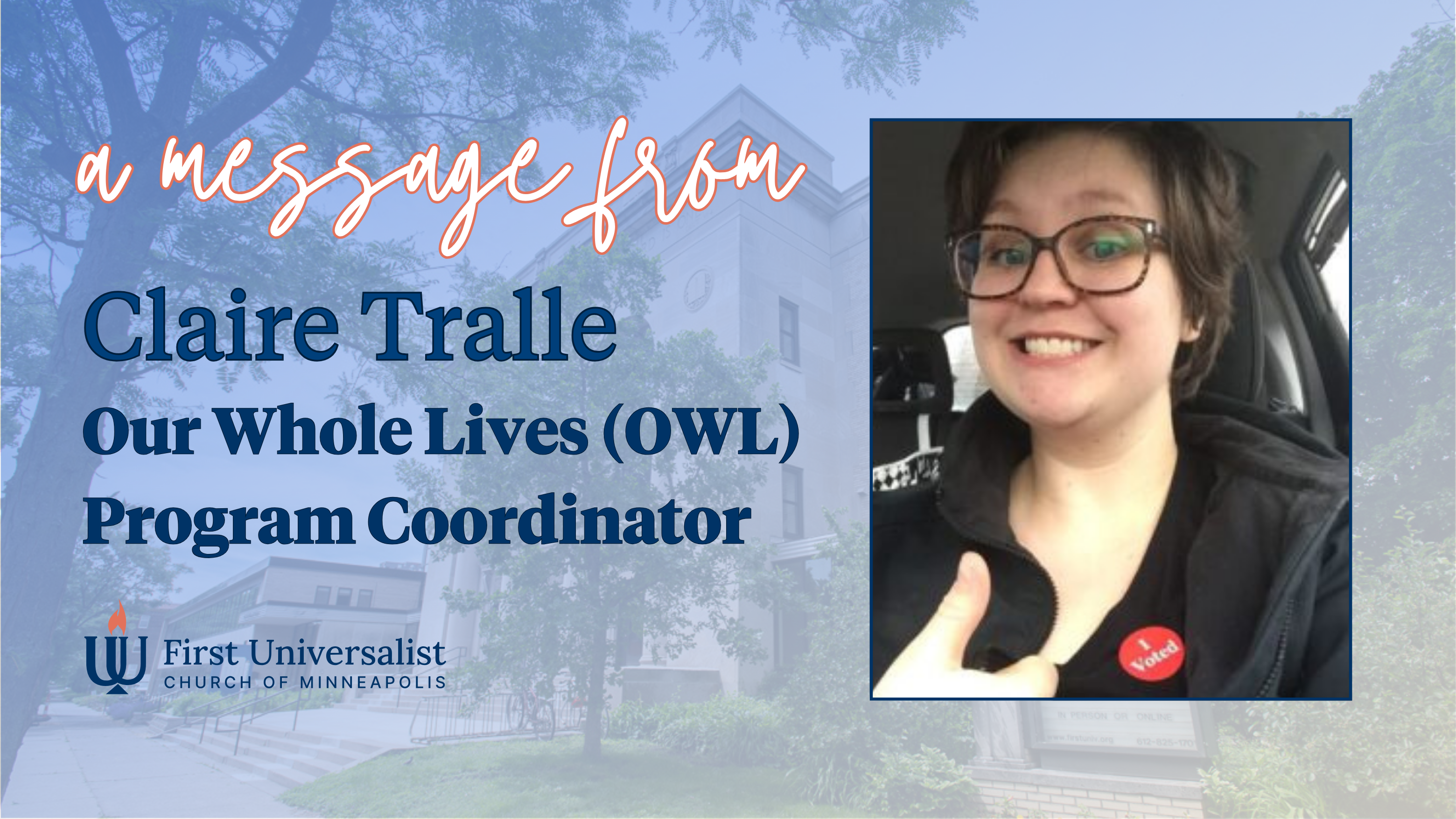
This has been an incredibly difficult time for everyone, Our children are feeling it, too. If you, your family, or your child need anything during this time, please do not hesitate to reach out to myself or any of the First Universalist Staff. Please remember: you are not alone. We are holding this together.
We have tips collected by Dr. Katie Lingras, Child Psychologist and Associate Professor in the Department of Psychiatry and Behavioral Sciences at the University of Minnesota Medical School. We also have graphics below if words feel too heavy.
Claire Tralle, Our Whole Lives (OWL) Program Coordinator
claire [at] firstuniv [dot] org
Quick Tips for Parents/Caregivers:
What to Avoid:
- Minimizing fears: Don’t tell them “don’t be afraid,” as fear is a natural response.
- Giving false promises: Be honest about the uncertainty while offering hope.
- Repressing Emotions: Let them know it’s okay to be scared, sad, or angry.
Instead…
Look for signs kids might be stressed or picking up on tensions (explicit knowledge vs. implicit feeling of “something is wrong”). You may notice:
- Jumpiness, moodiness, regressions, withdrawing, trouble concentrating, trouble sleeping
Model Calmness: Deep breaths, routines (meals, homework), and managing your own anxiety helps them feel secure.
- This doesn’t mean you can’t also be angry/sad/etc., just make sure you’re grounded and regulated in interactions with kids
- Get back to the basics to re-gain regulation:
- Body fuel (nutritious food, hydration)
- Activity/exercise
- Sleep
- In control (feeling successful, completion, certainty)
- Connection
- Securing your own oxygen mask
Be Honest & Age-Appropriate: Acknowledge scary things are happening but explain in ways they understand (e.g., fairness for younger kids).
- Start with asking what they know, have heard, or wonder about.
- Use books, videos, and other materials to support conversations (review first).
Validate & Reassure: Say, “It’s okay to be scared,” and emphasize, “You are safe, we’re together, and we’ll protect you”
- Differentiate between what is a grown-up problem and what is a kid problem.
- “The grown-ups are doing everything they can. Your job is [to go to school and be kind to your friends and neighbors].” [adjust based on age]
Create a Safety Plan: Designate backup caregivers, practice what to do (e.g., don’t open the door to strangers/uniforms), and know your rights.
- Can be helpful for kids directly and indirectly affected. Teach important phone numbers, etc.
Teach Children and Youth Their Rights: Instruct kids to stay calm, say nothing to agents (names, addresses), record interactions if possible, and tell you immediately.
- Adjust based on age, but grownups can talk about the right to feel safe even with young children.
Build Empathy & Action: Teach kindness, highlight immigrants’ contributions, and find positive ways to support your community.
- Engage children in developmentally appropriate ways; young kids can attend protests and vigils at caregiver discretion (or create smaller opportunities with friends/neighbors)
Resources
Video: Supporting Children During Immigration Enforcement Operations
Pamphlets offered in multiple languages:
When Children Are Afraid of a Parent’s Deportation
Supporting Children After A Parent’s Deportation or Detention
Expert Tips on Talking to Kids about I.C.E.
Reading List: Support Children through Scary News, Violence & Family Separation
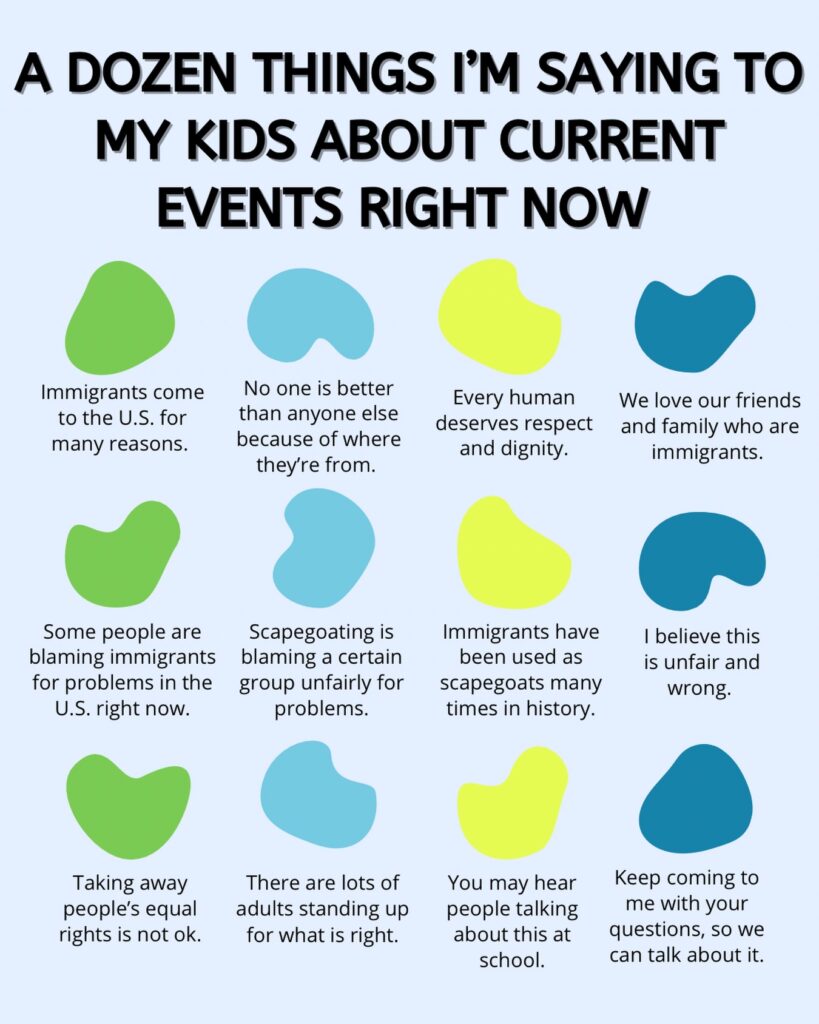
A Dozen Things I’m Saying to My Kids about Current Events Right Now:
- Immigrants come to the U.S. for many reasons.
- No one is better than anyone else because of where they’re from.
- Every human deserves respect and dignity.
- We love our friends and family who are immigrants.
- Some people are blaming immigrants for problems in the U.S. right now.
- Scapegoating is blaming a certain group unfairly for problems.
- Immigrants have been used as scapegoats many times in history.
- I believe this is unfair and wrong.
- Taking away people’s equal rights is not ok.
- There are lots of adults standing up for what is right.
- You may hear people talking about this at school.
- Keep coming to me with your questions, so we can talk about it.
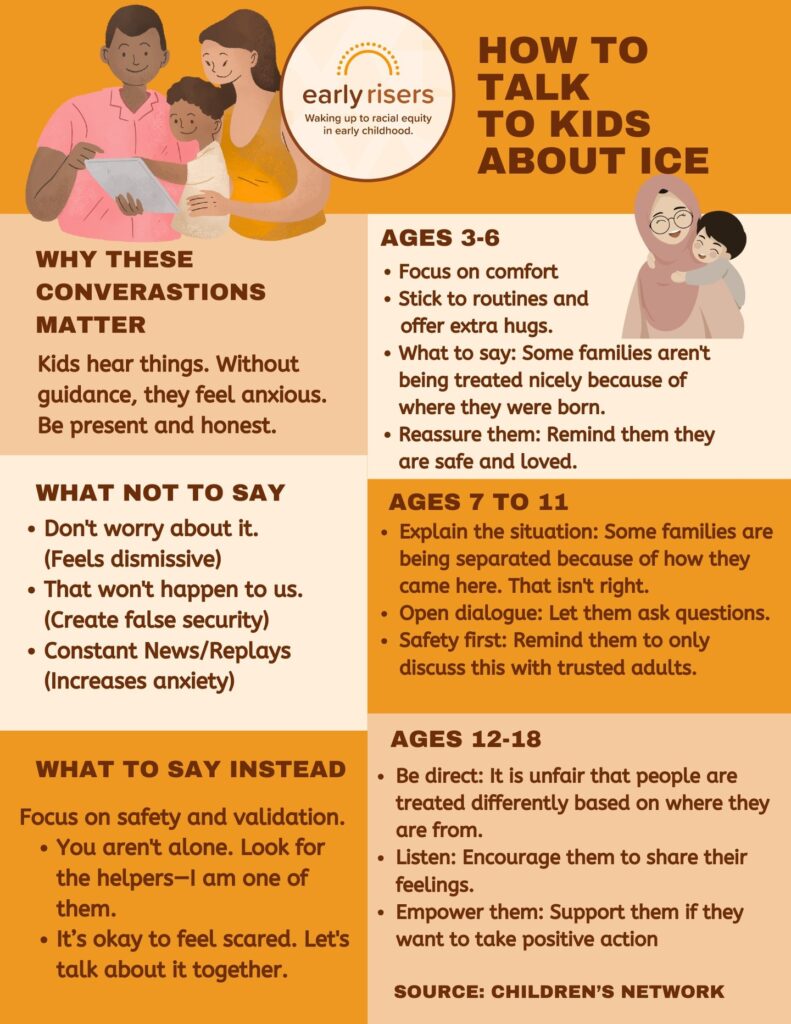
Talking to Your Kids About ICE: A Guide for Parents
Why these conversations matter
Kids hear things. Without guidance, they feel anxious. Be present and honest.
What not to say
- “Don’t worry about it.” (Feels dismissive.)
- “That won’t happen to us.” (Creates false security.)
- Constant news/replays (increases anxiety).
What to say instead
Focus on safety and validation.
- “You aren’t alone. Look for the helpers—I am one of them.”
- “It’s okay to feel scared. Let’s talk about it together.”
Ages 3-6
- Focus on comfort.
- Stick to routines and offer extra hugs.
- What to say: Some families aren’t being treated nicely because of where they were born.
- Reassure them: Remind them they are safe and loved.
Ages 7 to 11
- Explain the situation: Some families are being separated because of how they came here. That isn’t right.
- Open dialogue: Let them ask questions.
- Safety first: Remind them to only discuss this with trusted adults.
Ages 12-18
- Be direct: It is unfair that people are treated differently based on where they are from.
- Listen: Encourage them to share their feelings.
- Empower them: Support them if they want to take positive action.
This information was provided by the Children’s Network. You can access the full guide to see tips for specific ages, download a family safety plan, and view this information in Spanish on their website HERE.